skip to main |
skip to sidebar
No
Reservations
Tony muses about crossing the river into Brooklyn, where the show started 8
years back, and opens with Tony riding the 85 year-old “The Cyclone” roller coaster at Coney
Island, a ride he somehow missed in his youth. He hits different areas
in Brooklyn, while riffing on the mix of people, cultures, and food that are
found there. It’s a mini-world tour all by itself.
Crown Heights:
Gloria’s # 3 West Indian Restaurant (the one at 764 Nostrand) with Omar from The
Wire (Michael K. Williams, who everyone on the street seemed to know
personally): curried goat, oxtails, mac ‘n cheese (which looked like a wedge of
cake), callaloo greens. All tasting righteous and sinfully good according to
the guys.
Columbia St. Waterfront:
Andy Ricker’s Pok Pok with Eddie Huang of Baohaus and Fresh Off the
Boat blog, set up to mimic a Thai-Isaan
café, with plastic plates and great service (which is atypical of this sort of
spot in Thailand): laab, rotisseried and basted Isaan-style gai yang chicken with
properly zippy som tam green papaya salad, grilled pork neck, some greens they
never named (or if they did I missed it), and the Thai specialty called “jelly
beer” (almost frozen, slushy Bia Singha). Tony says that it’s the best Thai
food he’s eaten outside of Thailand, and Tony should know, having traveled to
the region frequently.
Red Hook:
Ralph’s Playhouse Toy Museum, where Ralph Balzano houses a spectacular
collection of old toys and classic cars. He and Tony cruise the borough in a
convertible ’59 or ’60 Buick Electra with monster tail fins and head for his
brother’s bar, Sunny’s, for a drink. It’s owned by Sunny Balzano, the
“Grandfather of Red Hook’, and the joint hasn’t changed a lick in eons
(family-owned since 1890).

Sheepshead Bay:
Randazzo’s Clam Bar (“The Pride of Sheepshead Bay”) on Emmons St., opened in
1960, but the family worked in the seafood markets since 1916: huge portions of
red checkered table cloth Italian food, especially seafood. Blue collar, working
man’s meals with a menu straight out of the 60’s, and side orders of pasta.
Tony gets a massive platter of Lobster Fra Diavalo (that also has clams,
shrimp, mussels, all in a spicy marinara sauce) and he and the Torrisi Brothers
(Rich Torrisi and Mario Carbone, from Torrisi Italian Specialties) split a huge
order of calamari marinara. Their plates are equally massive; so big the meal
almost looks painful.
Bushwick:
Roberta’s Bread (and Pizza) on Moore St., a coop restaurant-performance space. Tony
and rapper Kalib Kweli go upstairs to Blanca, a foodie cult favorite where they
only book 12 diners a night, on a counter in a huge, very well-equipped kitchen
(an unthinkable waste of seating space that would be the death of any other
restaurant). Chef Carlo Mirachi only
does what he wants to do, based on what’s fresh that day, and puts out a 25 to
31-course tasting menu four nights a week. Tony looks like he really enjoys
each little bite, while Kalib concurs.
Sheepshead Bay again, to go fishing with Dave Pasternak of the famed Italian seafood
bistro, Esca. First they stop off at
Roll ‘n Roaster on Emmons for a big stacked beef sandwich (open since 1970). Tony
catches fish for the first time in 8 years of fishing on the show (probably
because he appears to be a horrible angler, and it’s a wonder the rod wasn’t
ripped from his hand; he holds it like an 8 year-old girl, and has no concept
of angling the fish, or leverage, or pescatory physics or geometry): 1 bluefish
and 3 stripers, which get scaled and grilled dockside, drizzled with olive oil,
lemon, sea salt, and garlic, with a bit of rosemary sprinkled on top; declared
by all to be perfect.
Brighton Beach with his legendary traveling nemesis Zamir:
Primorski Restaurant on Brighton Beach Ave: half empty, with a horribly cheesy 70’s
Russian lounge act onstage, and a sparkling disco ball: blini with caviar,
dolmas, lots and lots of vodka, and a fantastic looking whole sucking pig, that
they end up offering to the rest of the dining room to finish.

Downtown Brooklyn with Eric Ripert:
Chef’s Table at Brooklyn Fare Kitchen on Schermerhorn St.: 18 seats only, 20 to
26 courses, and Brooklyn’s only 3* Michelin restaurant by Chef Cesar Ramirez.
The menu is seafood heavy, much of it flown over daily from the famed Tokyo Tsukiji
Fish market; tiny bites of perfect food that Tony and Eric swoon over.
Jewish Deli:
Jay and Lloyd’s Kosher Deli in Sheepshead bay, on Avenue U, a three-generation
Kosher deli famed for their pastrami. Tony
has a chopped liver plate, pastrami on rye sandwich, and a Dr. Brown’s Cream
Soda…”the consummate Jewish deli meal.”
Tony’s final words, admonishing the viewers to seek out food adventures and new
experiences, and break out of the comfortable status quo: “MOVE…across the
oceans, or across the river.” With shots of the Brooklyn Bridge fading out
Denouement: We watch the credits fade on what is supposed to be Tony’s final
show on the Travel Channel, only to get a tease that in a couple of weeks, the
final episodes of Tony’s travel show, The Layover, will begin its own swan
song. Dang if I won’t watch that one also. Bourdain is one of the best, most
irreverently entertaining things that has ever happened to food writing and
food television, and I can’t wait for his new gigs at CNN and ABC to hit the small screen.
Mick Vann ©
The stir fry that Sap did after the soup was Pad Ped Pla Grai, which is based on a fresh herb green curry paste made from galangal, lemongrass, makroot leaves, and Thai chiles. Some add garlic to the paste when pounding it or processing it, but Sap thinks it's better to add it separately, after adding the spice paste, so that it doesn't have much of a chance to scorch and get bitter. The dish is similar to an item on the Sap's menu, Amazing Mussels (S-P28), Amazing Green Beans (S-P31), and Pad Ped Nor Mai (S-P32). All of these dishes feature a fresh herb based curry paste.This particular dish will be appearing on the menu shortly.

Pad Ped Nor Mai, S-P32, above
Pad
Ped Pla Grai –
Fish Balls and Bamboo Shoots with Fresh Curry
serves 4
This easy stir fry gets its flavor from an herbal paste that you process or
pound before beginning the dish. It uses galangal, lemongrass, Thai lime leaf, and
Thai chiles as the flavor base, joined Serrano chiles, garlic, a few bottled
sauces, and some holy basil. Traditionally it is made with fish balls,
dumplings made from a seasoned paste of fish fillet. The best fish balls are
made from pla grai, (Giant Featherback, or Knifefish, Chitala
lopsis) a freshwater fish that can grow to 3+ feet in length, with a caudal
hump, a single feathery fin that runs from gill to tail on the bottom, and 5 to
10 spots on the back half that resemble eyes, like a redfish. It has a sweet,
soft flesh that gets seasoned and then pounded into a paste using a mortar and
pestle. The balls or patties should have a toothsome texture; they should have
bite and resistance to be authentic. In Thailand you can buy the paste already
pounded and make your own, but here you can get fresh or frozen fish balls at
MT Market.
Fresh Spice Paste:
yields
about 12 oz, enough for two batches of this dish
¼ cup sliced galangal
1 large stalk lemongrass, sliced thinly
¼ cup Thai lime leaves (makroot)
20 Thai chiles, chopped
Put all ingredients in the bowl of a food processor and process into a fine
paste. The paste can be frozen in an airtight freezer bag or container.
Stir fry:
2-3 Tbl rice bran oil or vegetable oil
6 to 10 serrano chiles, sliced
6 oz spice paste
2 Tbl garlic
20 leaves of holy basil
1½ cups quartered mushrooms, or straw mushrooms
16 oz “slender” bamboo shoots (a canned Chinese product)
1 # fish balls (pla grai if possible)
2 Tbl Thai fish sauce
2 Tbl Thai Maggi sauce
2 Tbl Thai oyster sauce (the best Thai brand is Dragonfly Super Premium, next
would be Mae Krua, followed by Chinese
brand Lee Kum Kee)
2 tsp sugar
Steamed jasmine rice for service
Heat the oil in a wok until smoking and add serranos, sautéing 1 to 2 minutes
to flavor the oil (be wary of the vapors release). Add the spice paste and
sauté for 2 minutes; add the garlic, sautéing for 30 seconds. Add mushrooms, holy
basil, and bamboo shoots and sauté for 4 minutes. Add fish sauce, Maggi sauce,
oyster sauce, and sugar, and toss well. Serve accompanied by steamed Thai jasmine
rice.
Note: Any seafood, meat, or vegetables can be substituted for the fish balls,
but it is traditionally a seafood dish. Instead of bamboo shoots, you can
substitute hearts of palm; traditionally the dish is made with quartered Thai
“apple” eggplants, which are about the size of a ping pong ball. If it is out
of season for holy basil, substitute sweet basil, adding it at the very end,
just to wilt the leaves. If you are vegetarian or allergic to shellfish, soy
sauce can be substituted for the oyster sauce.

Sap stir-frying, and the crowd edging forward in anticipation of a taste

The Big Four, top, clockwise: makroot (Thai lime leaf), lemongrass, galangal (rhizome and slices), Thai chiles
Lemongrass: takhrai, ta-krai (ตะไคร้)
Cymbopogon
citrates
Lemongrass is one of the most heavily used herbs in Thai cooking, added
to a wide range of dishes in one form or another. The flavor is of a subtle
lemon-like taste with a perfumed herbal quality. Since the leaves are tough and
fibrous, the light-colored part of the stem is preferred. It needs to be minced
very finely across the grain and then ground finely in a mortar and pestle, or
an electric coffee mill, or kept in pieces so that it can easily be avoided and
not bitten into. If kept in larger chunks for use, they should first be bruised
with the back of a knife to release more flavor. It is best used fresh, right
out of the ground, but it can be frozen for later use. It is used primarily in
curries and soups, and makes an excellent tea or sorbet. Hint: to clean your
electric spice mill, grind up some raw white rice and discard it once the
interior of the mill is clean.
To grow lemongrass here, plant it in deep, rich, well-draining soil in full
sun, and keep it evenly moist; it should have some winter wind protection.
Before winter, mulch it heavily and it will probably survive and come up the
following spring. Harvest the stalks by cutting from the outside of the clump.
For more information on Thai lime leaf, see my blog:
http://gustidude.blogspot.com/2012/09/thai-lime-leaf-why-names-are-important.html
For more information on holy basil, ditto:
http://gustidude.blogspot.com/2012/10/pud-ped-gaprao-thai-hamburger-helper.html
For info on the health and culinary benefits of cooking with rice bran oil, see my blog:
http://gustidude.blogspot.com/2010/04/rice-bran-oil-healthiest-cooking-oil.html
* * *
Mick Vann – food writer, cookbook author, chef, restaurant consultant,
horticulturist
gustidude.blogspot.com
The Appetizer Atlas: A World of Small
Bites; Wiley, 2003; Gourmand World Cookbook Awards 2004: World’s Best Foreign Language Cookbook
mick@austin.utexas.edu
Sap Apisaksari – Sap’s Fine Thai Cuisine, 4514 West Gate Blvd (Westgate at Ben
White),
899-8525; http://sapsthai.com/index.html
Dangerous Grounds Starts Tonight
Tonight at 9 pm CST on
The Travel Channel, a new one-hour series begins: Dangerous Grounds. Todd
Carmichael, CEO and
co-founder of the Philadelphia-based coffee chain La Colombe Torrefaction (seven locations, in
NYC, Philly, Seoul, Chicago) and real life adventurer and humanitarian, travels to “some
of the most fascinating and unseen places in the world” in
search of the highest quality and rarest coffee beans. Destinations for the
eight shows include Haiti, Bolivia, Madagascar, Borneo,
Cuba, and Vietnam (please let this episode be about the Dak Lak civet cat-poop
beans!).

As for the dangerous part,
previews tease us with shots of him sliding-dangling across a very deep ravine
on a thin cable, and this line: “Oh…there’s a dead body.” He’s described as
sleeping under his truck to avoid armed robbers, and having to McGiver his engine
to keep it going in the middle of nowhere. To his credit, he is searching for
the rare beans with a big wad of cash, bypassing middlemen, and buying directly with
the growers. The tease is a good one, and the show looks like it might be stimulating (intended), especially for the caffeine freaks in our midst. The
show will move to its regular time slot on Tuesday, November 13, 8pm CST.

Preceding the premier of
Dangerous Grounds at 8pm CST is the very last episode of Tony Bourdain’s No Reservations.
After eight seasons of gustatory globetrotting, the sharpest-tongued, most
entertaining, and wittiest food personality on the tube performs his swan song in
Brooklyn before moving on to greener pastures (CNN, ABC, and his own publishing
line with Harper Collins). The two shows combined should make for some fantastic
and captivating viewing, and a welcome relief from mind-numbing campaign coverage.
Travel Channel:
ATX T-W: CH 33
Dish CH 196
Direct TV: CH 277
ATX Grande: CH 58
Mick Vann ©
Yesterday afternoon Sap Apisaksiri of Sap’s Fine Thai Cuisine (on Westgate, and Austin's best Thai restaurant) and I
taught a culinary class together, at Chris and Diane Winslow’s It’s About Thyme
Nursery, the best source in the region for culinary herbs. I lectured on Thai herbs
and culinary culture while Sap joined in, and did a cooking demo of spicy
coconut and chicken soup, tom kha, and a quick stir fry with fresh herb curry
and fish cakes, pad ped pla grai. We talked about a myriad of different aspects
of Thai cuisine, and most of the primary ingredients used in Thai
cooking, and the good sized crowd got to sample a couple of excellent dishes. In
this first entry I’ll cover the soup portion of the handout that they got at the lecture; tomorrow the
second half, the stir fry.

The big four of Thai seasoning, upper left, clockwise: makroot (Thai lime leaf), lemongrass, galangal (rhizome and sliced), Thai chiles
Tom Kha Gai – Spicy Coconut and Galangal Soup with Chicken
Tom
kha gai is
a Thai soup known by most Westerners. It is an example of a more complex soup,
where the base is primarily coconut milk and coconut cream, reinforced with
chicken stock for depth (many Thai soups are fairly basic, unlike the soupy
curries). Usually made with chicken meat, it is seasoned with lime juice, palm
sugar, lemongrass, makroot leaves, galangal (the kha of tom kha),
chiles, fish sauce, and cilantro. You can always distinguish a good tom kha by
the amount of coconut cream and galangal used in the soup; the more of each
used, the more expensive it is to produce, and the better it tastes. There are
some amazingly vapid versions of tom kha produced in the States, where
little coconut milk and no coconut cream is used, and the use of
galangal is an afterthought. The more complex the soup is, the more difficult
it is to balance the seasonings so that they all contribute to the whole, yet
do not overshadow each other. As with all Thai food, the major flavor
components are present: hot, sour, salty, sweet. It should taste creamy, rich,
and spicy, with a faint tart note from the lime, and some base saltiness from
the fish sauce on the finish.

An ocean of 4" galangal plants ready for sale, at It's About Thyme
Galangal:
kha (ข่า)
Alpina galangal (A. nigra)
Galangal is heavily used in Thai cuisine, especially in association with
seafood, as it minimizes ‘fishiness’. It is most known to Westerners through
its use in Tom kha chicken and
coconut cream soup, and it should be an assertive flavor in that dish (tom = soup, kha = galangal). It is sold as a fresh rhizome, or sliced and
frozen. When rhizomes are young they are white to creamy, with pink tips; young
galangal is best used in soups and stews. The flavor is gingery and floral,
with an herbal, peppery finish. As the rhizome matures, it gets a thicker skin,
and the color deepens to a burnished gold or amber, and the flavor gets more
piquant and peppery; older rhizome is best for curries.
Galangal
(Alpina galangal) can be grown here
as a tropical, with a minimum temperature of 34°F or so, technically it is
rated as Zone 9-10, which is a minimum of 20 to 30°F. It wants morning sun and
afternoon shade for best rhizome production, although it will grow in full
shade. It should be planted in a spot with good north wind protection, in rich
soil, and mulched heavily. The plant should be kept lightly moist and wants
good drainage. It likes a balanced food every 2 months or so, and will take a
full 6 to 9 months to produce harvestable rhizomes. Expect the clump to get 4
to 6 feet tall. The
flavor is gingery and floral, with citrus undertones and a peppery finish.

A herd of 4" makroot plants (Thai lime leaf) for sale at IAT.

A steaming bowl of rich, spicy coconut cream soup: Tom Kha Gai
Tom Kha Gai – Spicy Coconut and Galangal
Soup with Chicken serves
4 to 6
- 2 cups chicken stock
- 1 cup mushrooms, sliced ¼” (or canned straw mushroom equivalent)
- 8 Thai lime leaves, bruised to release flavor, torn into pieces
- 6 2-inch pieces of lemongrass, bruised to release flavor
- 2 to 3-inch cube (or equivalent in frozen slices) galangal, sliced thinly
- 4 tablespoons Thai fish sauce (Golden Boy or Tra Chang [“weighing scale”])
- 3 to 4 tablespoons lime juice, to taste
- 2 teaspoon palm sugar, to taste
- 6 oz chicken boneless breast or thigh, sliced thinly
- 2 each 13.5 oz cans Chaokoh coconut milk, shaken
- 10 to 14 small red Thai chiles, crushed (or equivalent in nahm phrik pao
roasted chile paste:Sap's Homemade
[available for sale at restaurant], or Mae Ploy brand [“Chilli in Oil”], or Butterfly Brand)
- Cilantro leaves, to garnish
- Cooked jasmine rice, to serve
Heat the stock, add the mushrooms, lime leaves, lemongrass, galangal, fish
sauce, and lime juice. Stir thoroughly, bring to a boil, and add the coconut
milk, and then the chile peppers. Bring back to the boil, lower the heat to a
simmer and cook for about 5 minutes to allow the flavors to develop. Bring back
just to the boil, stir in the chicken slices, and immediately turn off the
heat. Portion into thick bowls, garnish each with cilantro leaves, and serve
with jasmine rice on the side.
NOTE: This soup is not intended to be
eaten over the rice, or for the rice to be mixed into the soup (except at the
very end, to absorb every drop of the broth), but to eat the soup separately,
with bites of rice interspersed. The soup can be made with seafood of any kind,
especially shellfish, instead of the chicken (pork or beef can be substituted as
well). It can also be made with tofu, preferably cubes of crispy fried tofu,
which can be purchased pre-cooked at Asian markets. Another substitute for the
chicken is sliced cooked artichoke hearts, which serve as a substitute for banana
blossoms.
Mick Vann ©
14005 Hwy. 183 N.
#1000; 258-1365
Lunch: Tue.-Fri., 11am-2pm, Sat.-Sun., 11:30am-2:30pm
Dinner: Tue.-Sat., 5-10pm; Sun., 5-9pm
www.spinmodernthai.com

A couple of buddies and I ventured out to the hinterlands (for me anyway, since
I live way south) to try Spin Modern Thai Cuisine. It’s the creative newish
venture from Ek Timrerk (East Side King co-founder, with three years at Uchi)
and Uchiko veteran Thai Changthong that’s been open 4 months or so. If memory
serves, it’s in a Cedar Park shopping complex called Walden Plaza, on the east
side of 183, halfway twixt TX 45 and Lakeline Blvd; if going north on 183, you
take the last exit before the toll road starts. It’s directly across 183 from Lakeline
Mall. The name SPIN comes from their menu of new twists on traditional Thai
cuisine, with some pan-Asian thrown in for good measure, and a healthy nod
towards fresh, local, and seasonal. Spin also refers to the changing menu. Lunch
is more street-food oriented, with cheaper prices and faster service.

The brigade, L to R: Ek Timrerk, Thai Changthong, David Baek
The space is lengthy and slightly narrow, with stained concrete floors, lots of
dark wood, accent lighting, and a mix of sea foam green and taupe. Contemporary
upbeat music plays at a pleasant elevated level, and a serving bar is placed in
front of the gleaming open kitchen. The vibe is hip, unpretentious, comfortable,
and welcoming. Portions are bigger than I expected, and for the price, and the
quality of the ingredients, you definitely get value. Linda, our server, was
efficient, knowledgeable, unobtrusive, and downright pleasant; all you can ask
for in a server.
We started with hor mok salmon, done here like an elongated, croquette, topped
with a julienned salad with a nice garlicky kick, good chile spice, and a
creamy sauce; different from tradition, but delicious.

Next was lin wua ($12), slices of rich, unctuous sous-vide beef tongue nicely seared
and crispy on the outside, on a kabocha squash puree elevated with curry paste,
with sweet corn, Chinese broccoli leaves, cherry tomatoes, bacon, and a
balsamic drizzle; might sound busy, but it all worked together perfectly.

A decidedly zippy som tam salad arrived, with julienned green papaya, green
bean, cherry tomatoes, peanuts, and a 5-chile rated dressing made from shrimp paste,
lime, and fish sauce. The flavor was very authentic, but I thought it needed
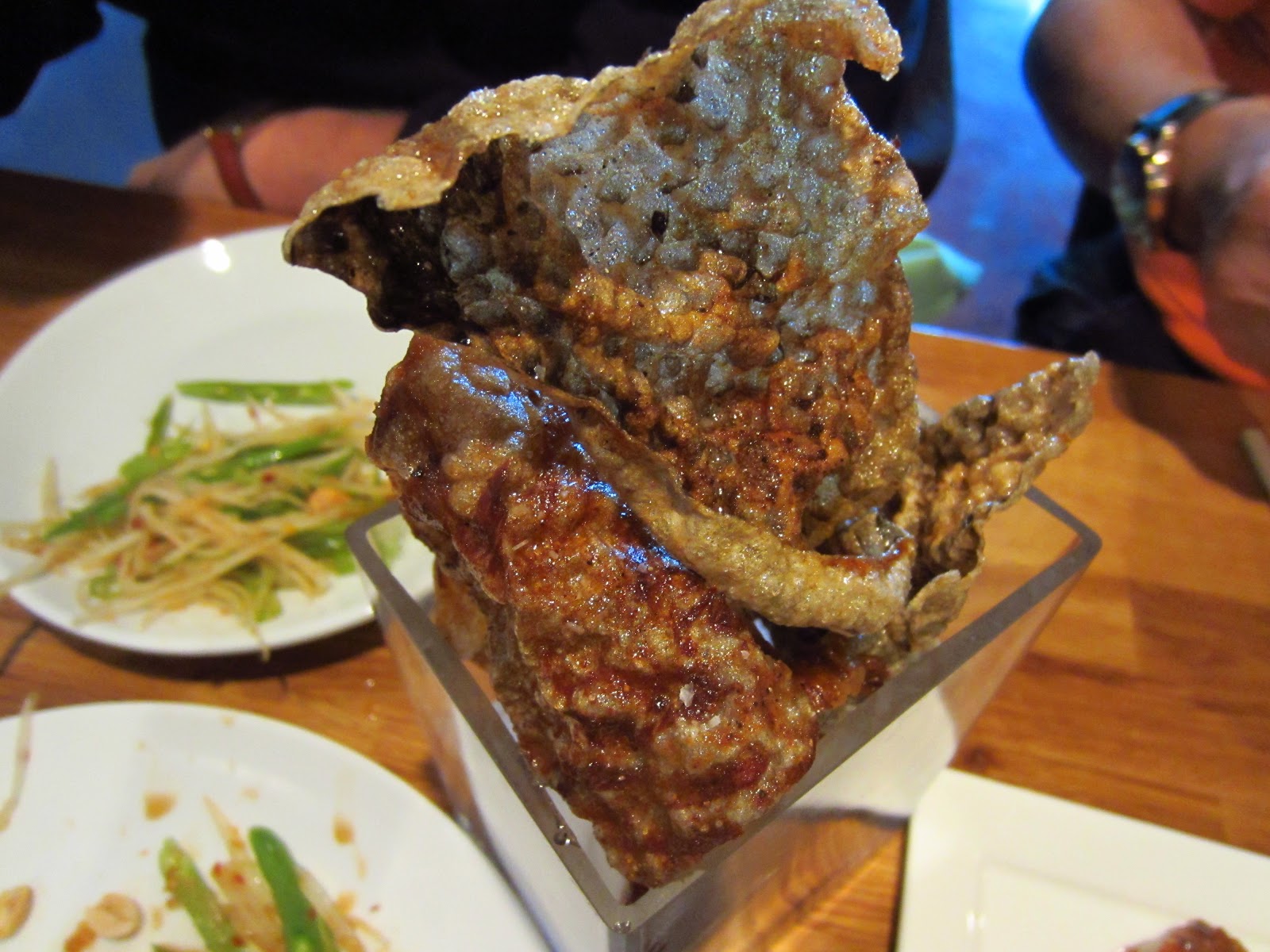
just a dab of sugar to balance the lime. Ek brought us out a cylinder filled
with crispy fried salmon skin, which was the perfect crunchy accompaniment to
the salad. In classic Isaan fashion, we
ordered it with a half gai yang grilled chicken ($10, that day's special) that arrived with burnished
crackling skin and moist flesh, paired with a sweet chile sauce and a funkier,
soulful tamarind-chile sauce that we loved (some shrimp paste maybe?); a
delectable trio.

Som tam salad

Gai yang chicken

Crispy salmon skin
Pud cha soft shell crab ($15) was next, done tempura style and topped with the
sauce: sweet, salty, spicy, with basil and young peppercorn; again, tradition
with a twist, and quite tasty.

Belly on fire ($14) was on our radar: melt-in-your-mouth thick slices of pork
belly with panko-breaded crispy skin, topped with curry sauce, with fresh
julienne green beans, Chinese celery slivers, caramelized cipollini onions, basil, and toasted chili: sinfully rich
and well balanced.

Goong op woon sen (“clay pot shrimp”, $16) was the final dish, and it’s one of
my overall Thai favorites; easy to do, but seldom seen on menus over here. A
sizzling clay pot emerges topped with three large perfectly cooked shrimp,
lying on a fried egg, on a bed of glass noodles, seasoned with shitake
mushroom, whole peppercorns, bacon, scallion, and a sauce of garlic and ginger,
sweet soy, fish sauce, and oyster sauce. I loved it, but thought it was just a tad
bit sweet.

So we were sitting there stuffed when the cooking brigade sends out a couple of
desserts for us to nibble on. Coconut panna cotta ($6) arrived with salted,
caramelized pecans and a caramel tuile. I hate to criticize something brought
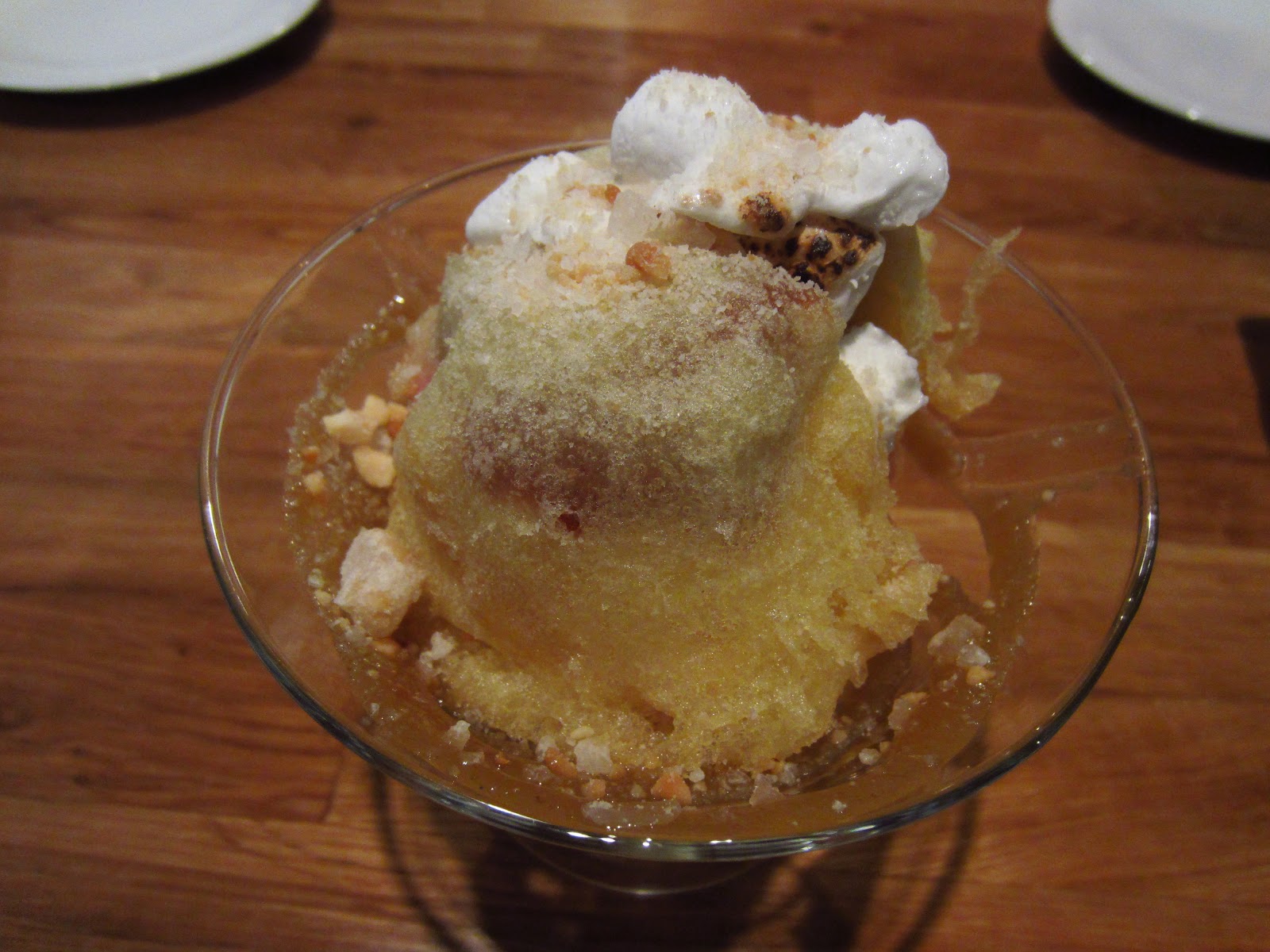
gratis, but it could have been richer and sweeter. A dish of fried ice cream
($6) was a ball of strawberry ice cream fried in pound cake tempura batter,
drizzled with a syrup and topped with caramelized marshmallows; I liked it
fine, but it needed a bigger ball of ice cream to balance the fried crust
(which is tasty in its own right).


Bottom line? We all loved our meal, and I was frankly surprised that it wasn’t
busier than half-full at 7:00 on a Thursday evening. SPIN should have a line
out the door all the time. Ek and Thai are doing some really delicious, creative
twists on traditional Thai (and the pan-Asian menu items that aren’t Thai). Good
stuff, go there!
Mick Vann ©